Just Cryptoeconomics · April 9, 2026
Why Fundamentals Exists
Why Fundamentals exists. A framework for analysing cryptoeconomic systems and tokens through three distinct layers: sector, system, and token functionality.
Crypto investment analysis is hard because neither tokens nor the systems behind them are standardised. Tokens are not equity or debt instruments, and the systems they relate to are not neatly comparable to companies or issuer agreements. Bitcoin is not Binance. Ethereum is not Circle. Serious analysis therefore requires a framework built for cryptoeconomic systems themselves.
For years, much of the market has been driven by narrative, reflexive supply dynamics, and short-horizon trading structure. That was partly a function of the industry’s stage of development. Many systems were early, products were thin, and capital was flowing in fast enough for market structure to dominate underlying economics.
That environment is changing. Products and services are maturing, more systems now do economically legible work, and more capital is looking for ways to assess the industry on a longer time horizon. Narrative and market structure still matter, but they are no longer enough.
Fundamentals was built for that shift. It is designed to help users understand how cryptoeconomic systems work, where value is created and captured, and what role, if any, token ownership genuinely plays within them. We believe there are many considerations that matter to an investment decision, including technology, product, market dynamics, distribution, and network effects. But understanding the system and the token is the missing first step.
Fundamentals is an analytics dashboard and product from Just Cryptoeconomics that provides structured, comparable analysis of cryptoeconomic systems and tokens. The goal is to help users understand what a system actually sells, how it operates, where value is created and captured, who governs its essential components, and what role, if any, its token genuinely plays within that system.
The public documentation remains the reference guide to the labels and definitions used throughout the dashboard. These articles serve a different purpose. They explain the underlying logic of the framework, demonstrate the importance of key distinctions, and present a clear analytical process for interpreting cryptoeconomic systems and tokens more accurately. They are written for readers who do not want a simplified tour, but do want a rigorous way to think about cryptoeconomic systems and tokens.
At the centre of Fundamentals is a simple observation. Crypto analysis often blurs together questions that should be kept separate. What product or service does the system actually sell? How is the system structured, where is value created and captured, and who controls its material components? What rights or utilities genuinely require token ownership? These questions are connected, but they are not interchangeable. When they are collapsed into one another, comparison breaks down, token narratives start doing analytical work they cannot support, and precise-sounding language is frequently anything but.
That confusion has real consequences. If a system is assigned to the wrong sector, it will be compared against the wrong peer set, distorting benchmarking, expectations, and ultimately valuation. If value creation is not distinguished from value capture, and system-level capture is not distinguished from token-level accrual, investors can wrongly infer that system usage or demand necessarily benefits the token. If governance is discussed in slogans rather than in terms of actual decision rights over material components, control can be badly misunderstood. If token functionality is confused with mechanisms such as staking, locking, burning, or wrapping, tokens can appear more economically important than they really are. Weak cryptoeconomics analysis tends to lead to weak valuation work, and in turn, poorer investment decisions.
Fundamentals brings those questions back into order by working with two units of analysis, the system and the token, and by applying three distinct but connected layers of classification.
System. The economic system being analysed. In practice, it includes on-chain components and, where relevant, off-chain entities and infrastructure.
Token. A token is analysed only insofar as it has functional roles that require token ownership. A core principle of the Token Functionality Framework is that only those roles that require token ownership to engage with and benefit from a system qualify as functionalities.
This distinction matters because system significance does not automatically imply token significance. A system may generate substantial revenue through an off-chain business while its token governs only a narrow on-chain module. In that case, the system may matter economically while the token remains peripheral. One of the recurring weaknesses in crypto analysis is the tendency to talk as though the token simply is the system. Fundamentals therefore analyses the system first, and the token only insofar as token ownership is functionally relevant.
The first layer, Sector Classification, asks what buyer-facing product or service the system sells. This is the logical starting point. Before asking how a system works or what its token does, it is necessary to understand what the system is actually providing to users or buyers. Our view is that much of crypto’s historical sector language has been too loose. Systems are often grouped together because they look similar, use similar technology, or are already discussed together by the market. That is not a sound basis for classification. Sector classification should align with buyer-facing economic services, reflecting the logic of established financial industry classifications.
The second layer, System Taxonomy, asks what kind of economic system it is. This layer provides the structural context needed to interpret both the system and its token. It explains the system boundary, how the system operates, where value is created, where value is captured, how value is routed, and who governs its essential components. These questions are often compressed into broad labels that hide more than they reveal. Terms such as “decentralised” and “centralised” can sometimes be useful, but on their own they are usually far too blunt. What matters is not whether a system sounds decentralised in the abstract, but how its economically important components are actually structured, where productive activity occurs, where claims on value sit, and who has binding control over what.
The third layer, the Token Functionality Framework, asks what role the token actually plays within that system. Here, the key distinction is between token functionality and token mechanics. The question is not whether a token is promoted heavily or surrounded by mechanisms that create the appearance of utility. It is whether token ownership is genuinely required to perform a role, exercise a right, or receive a benefit. Only then does it qualify as functionality in our framework.
How Fundamentals Analyses Cryptoeconomic Systems
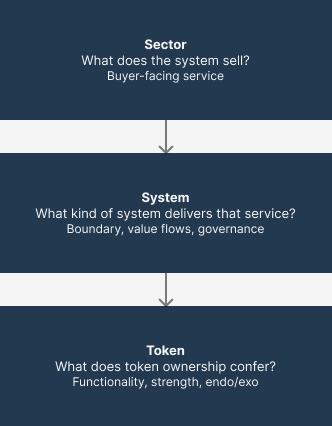
Fundamentals analyses cryptoeconomic systems in sequence: sector, system, then token.
The order of these analytical layers is deliberate. Tokens are downstream of systems. Their relevance, if any, depends on what the system sells, how the system is structured, where value is created and captured, and whether token ownership is meaningfully tied to participation, control, entitlement, or access. Starting with the token is therefore often the wrong move. A token can look important in isolation and much less important once the system context is clear. Equally, two tokens can share a headline label such as governance or payments while conferring very different rights in practice. By forcing sector, system, and token into a clear analytical sequence, Fundamentals is designed to help users analyse cryptoeconomic systems from first principles rather than from narrative shorthand.
The Fundamentals dashboard is the practical expression of that framework. Users can browse systems and tokens, compare them across shared labels, and open dedicated profiles that bring the three layers together. Each profile combines a system description, sector classification, system attributes, token functionality, and market context. The point is not to bury users in detail for its own sake. It is to surface the structure that serious analysis depends on, and to do so in a way that is repeatable across very different kinds of systems.

A Fundamentals profile brings sector, system, token, and market context together in one view.
Fundamentals did not appear from nowhere. It builds on earlier Just Cryptoeconomics research and writings, including our earlier public work on token functionality. The current product takes the next step by placing token analysis within a broader framework for sectors, systems, and token functionality. More broadly, it reflects the evolution of Just Cryptoeconomics itself. What began as research and framework development gradually pointed towards a product that lets users apply these ideas directly to live systems and tokens, compare them consistently, and test them in practice rather than leave them confined to documents alone.
The articles that follow explain that framework in the same order that Fundamentals uses it. Together, they show how to classify a system more accurately, read its structure more clearly, and judge whether its token meaningfully matters. We begin with Sector Classification, because the first question any serious analyst should ask is the simplest one. What does this system actually sell?